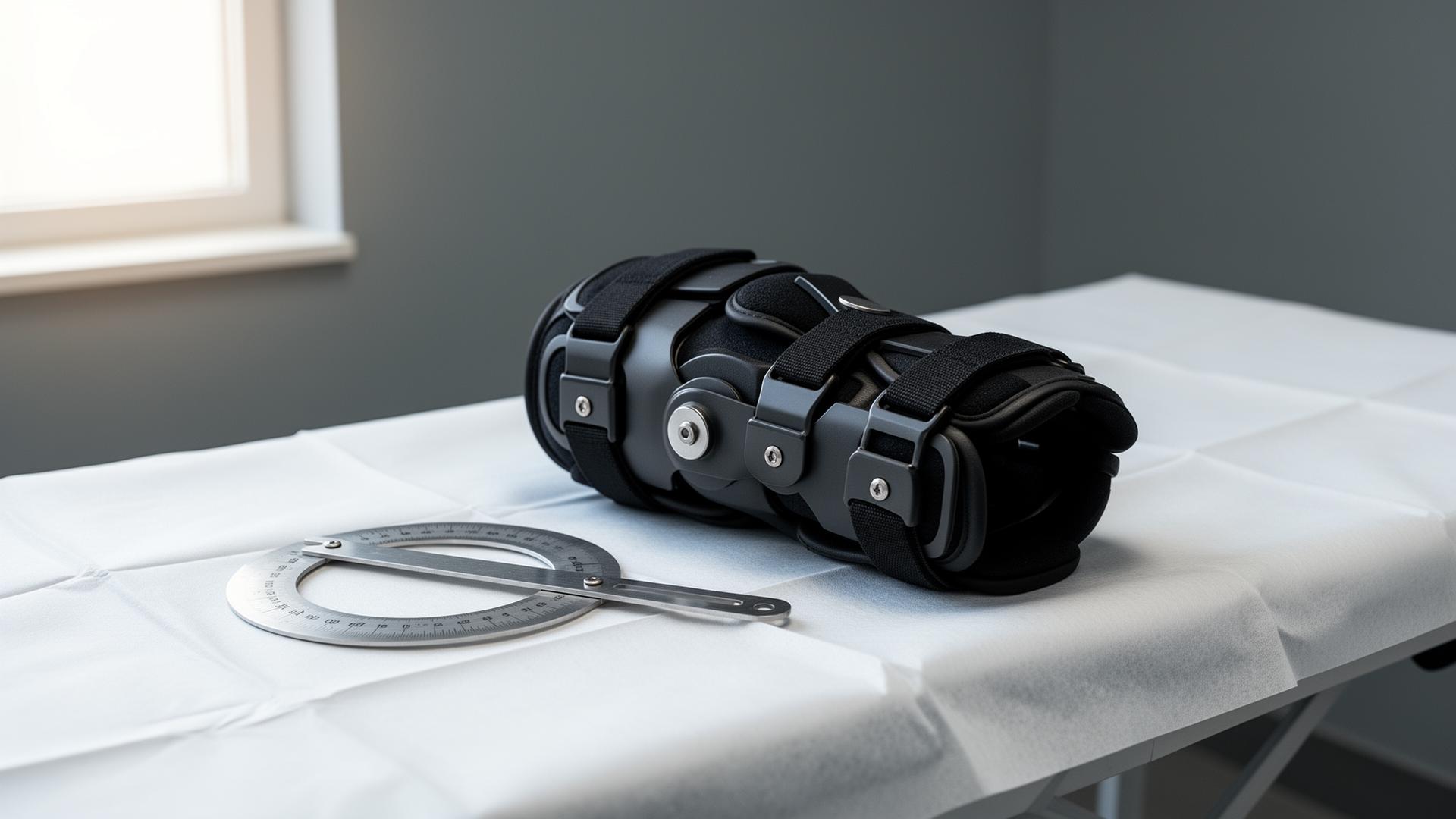
Anterior cruciate ligament (ACL) reconstruction outcomes hinge less on the calendar and more on criteria-based progression. The first 0–2 weeks emphasize protecting the graft, restoring full passive extension, and reactivating the quadriceps. Patients who chase early flexion at the cost of extension routinely struggle later with patellofemoral pain and a stiff gait pattern. Aim for symmetrical extension by the end of week one and quad activation that holds the patella superior during a straight-leg raise without lag.
Phase 1 · Protect and activate (weeks 0–2)
Cryotherapy and elevation reduce effusion, which is the single biggest driver of quad inhibition. Use heel props for ten to fifteen minutes several times per day to bias terminal extension. Quad sets, straight-leg raises with brace locked in extension, and ankle pumps form the daily backbone. Gait training with two crutches and partial weight-bearing prevents quad-avoidance patterns that linger for months when ignored. Document effusion using the stroke test at every visit.
Pain should trend downward week over week. If it does not, screen for cyclops lesion, infection, or graft irritation rather than simply pushing through. Sleep hygiene, protein intake at roughly 1.6 grams per kilogram per day, and managing systemic inflammation all materially affect tissue healing during this window. The brace stays locked in extension for ambulation and may be unlocked for seated knee flexion exercises as comfort allows. Patients often underestimate how much energy early rehab demands; schedule rest blocks deliberately.
Phase 2 · Restore symmetry (weeks 2–6)
By week three, most protocols allow weaning from crutches once the patient demonstrates a normalized gait without a quad-avoidance pattern. Closed-chain strengthening enters the program: mini-squats, leg press in a limited range, step-ups, and stationary cycling once 110 degrees of flexion is achieved. Open-chain knee extension remains restricted between roughly 90 and 45 degrees to limit anterior tibial translation on the healing graft, though recent evidence has softened this stance for hamstring autografts.
Neuromuscular control work begins in earnest here. Single-leg balance progressions on stable then unstable surfaces, perturbation training, and proprioceptive drills retrain the central nervous system to trust the reconstructed knee. The contralateral limb deserves equal attention because cross-education preserves strength and motor patterns that transfer back to the surgical side. Patients who skip this work pay for it in phase four when plyometrics expose the deficit.
Range of motion goals at six weeks: full extension, at least 125 degrees of flexion, minimal effusion, and a quadriceps index above sixty percent of the uninvolved side using handheld dynamometry. Patients who fall short of these markers should not advance to running progressions on the calendar alone. The temptation to push timelines because an athlete feels good is one of the most common drivers of revision surgery in the literature.
Phase 3 · Strength and running (weeks 6–16)
Strength work transitions toward heavier loading with squats, deadlifts, Bulgarian split squats, and Nordic hamstring curls. Volume should be high enough to drive hypertrophy: typically three to four sets of eight to twelve repetitions, three days per week, with progressive overload tracked weekly. Running reintroduction follows a treadmill walk-jog progression beginning at week twelve to sixteen, conditional on a quadriceps index above eighty percent and the absence of effusion after loading sessions.
Hamstring strength deserves disproportionate attention for hamstring autograft patients but matters for every reconstruction. The hamstrings are co-agonists with the ACL, restraining anterior tibial translation during dynamic loading. Nordics, Romanian deadlifts, and slider curls form a robust trio that can be programmed across the week. Calf and hip strength similarly distribute load away from the knee and should not be neglected because they feel less specific.
Aerobic conditioning often falls behind during this phase. Cycling, swimming once incisions are sealed, and rowing maintain cardiovascular fitness without high knee loads. Athletes returning to sport need a conditioning base that supports their sport's energy system demands; do not assume that strength work alone will rebuild it. A short conditioning block ahead of plyometric reintroduction prevents fatigue-driven faulty mechanics in the next phase.
Phase 4 · Plyometrics and return-to-sport (months 4–9+)
Plyometric reintroduction follows a double-leg, then single-leg, then sport-specific progression. Each tier requires symmetric mechanics on video review before advancing. Common faults include knee valgus on landing, trunk lean toward the surgical side, and asymmetric ground contact times. Force plate or video-based asymmetry indices below ten percent across hop tests are a reasonable threshold for advancing to cutting and pivoting drills, though no single test is sufficient alone.
Return-to-sport testing should be a battery, not a single assessment: isokinetic strength testing, a hop test battery, the y-balance test, and a sport-specific on-field assessment. Psychological readiness measured with the ACL-RSI questionnaire predicts re-injury independently of physical metrics and should be tracked monthly. Athletes who clear physical testing but score below sixty on ACL-RSI are at meaningfully higher risk of re-injury and benefit from extended graduated exposure rather than full clearance.
Re-injury risk remains elevated for at least two years post-reconstruction, and the contralateral knee carries similar risk to the surgical side. Maintenance programs emphasizing strength, neuromuscular control, and plyometric quality should continue indefinitely, especially for athletes returning to cutting and pivoting sports. Frame this with patients early so the end of formal rehab is understood as a transition to long-term performance training rather than a finish line.